This page was generated from the source of RoboHub. Edit the source, not this page.
RoboHub Gateway
robohub-gateway
The edge gateway for RoboHub firmware nodes.
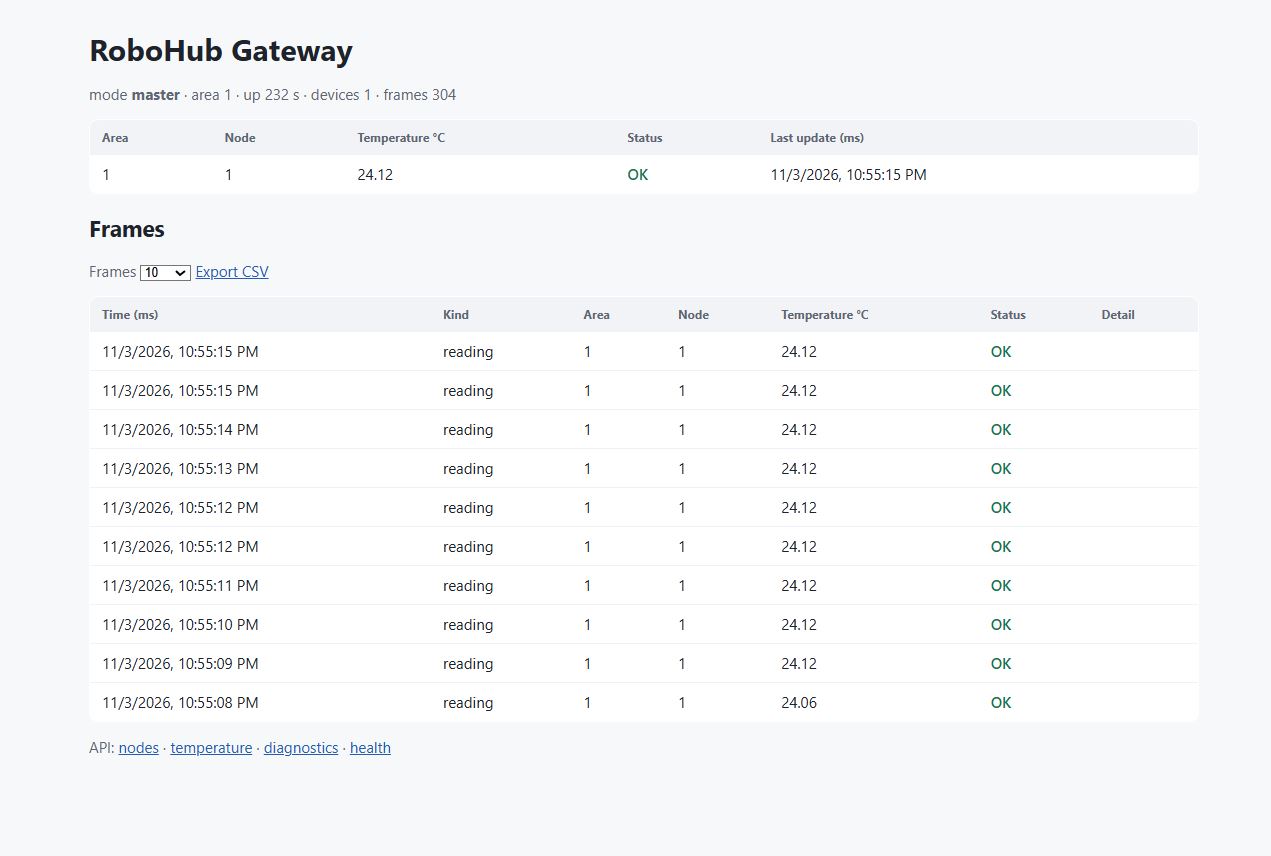
A node writes telemetry as COBS frames over serial. The gateway reads them,
keeps each board's latest values where an HTTP client can read them, forwards
every reading to PlotJuggler over UDP, and answers a REST call that asks a node
to change its sampling rate — an RPC over the same link.
It is written in Rho and generated into a Go server by rho build. The only
host-side parts are the ones Rho cannot express, and they are one port: opening
the serial link, sending a datagram, reading a monotonic clock, remembering
which boards have been heard from, and holding the state a reader and an HTTP
handler share.
Mesh builds, deploys and reads its gateways: each Mesh project has one, started
with that project's settings (see mesh/index). Mesh ingests the
gateway's outbox into its telemetry store (see mesh-telemetry/index),
and applications read the readings from Mesh, never from the gateway directly.
What it answers
Every route but /healthz needs a token (see Access below).
GET /api/v1/telemetry/temperature— the latest reading, from whichever device
sent it last.
{ "area_id": 7, "node_id": 1, "temperature_c": 24.38, "status": "OK", "last_updated_ms": 186095 }GET /api/v1/nodes— every device a frame has come from, each with its newest
values. A reading names its own device — an area and a node — so two boards
numbered 2 in different areas are two devices.GET /api/v1/telemetry/power,GET /api/v1/telemetry/state— the newest
power reading and device state, from whichever device sent it last.GET /api/v1/diagnostics— what the gateway itself is doing: the mode it was
deployed in, the area it speaks for, its uptime and what it has carried.GET /api/v1/nodes/{area}/{node}/diagnostics— asks one device to run its
hardware smoke and records the answer with the device. The request is sealed
under the board's session, on the link that session is held to (a relay's,
for a board behind one), as a command is;409when the board has none.GET /api/v1/keys— each board's key rotation as the gateway knows it: the
epoch the manifest names, the epoch the board confirmed, and what last
happened (confirmed, orcannotfor a board that has no store for a key).
See key epochs.POST /api/v1/nodes/{area}/{node}/sampling-rate,…/switch,…/command—
a control sent to a named device: its reporting interval, a switch (on or
off), or any opcode and argument (a device's own opcodes start at the vendor
base, so they cannot collide with a core one). A device in a child gateway's
area is reached down that child's uplink.POST /api/v1/devices— register a network device (name, kind, transport,
address, device id). The id is the device's stable identity: a client that
knows the hardware id passes it, one that does not getstransport:address,
and a second registration of the same id is refused rather than becoming a
second series.GET /api/v1/devices— the registered devices and their latest state.POST /api/v1/devices/{id}/poll— read an HTTP device's status.POST /api/v1/devices/{id}/switch— switch an HTTP device on or off; the
state may come as a form field or as?state=on|off.POST /api/v1/frames— accepts one encoded frame (without its delimiter) from
a network bridge holding acommandtoken. A Shelly or another IP device
reaches the gateway through a small poller; the frame is the one a board
sends, so it lands in the same device record and stream. The frames are a
board's own: a hello opens a session and is answered in the response,
{"success":true,"session":"<encoded SESSION frame, hex>"}— never on the
serial link — and a frame sealed under a session opened this way is taken as
that board's. A plain frame, or one sealed under a session of another link, is
refused (403):ALLOW_PLAIN_FRAMESis the serial link's alone.POST /api/v1/telemetry/sampling-rate— an RPC that changes a node's
reporting interval, answered200with the node's acknowledgement or504
when the node does not reply in time. A node may clamp the interval it can
meet and reports what it actually set.GET /— the gateway page: mode, area, uptime, devices, frames, the latest
values per node, and a frame history whose first row is newest. A node's
last_updated_msis its own uptime; the gateway's wall-clock
received_at_msis recorded beside it, and the page renders that locally. The history
window is/frames/{10|25|50|100|500|1000};/export/frames/<count>/csv
exports it. Every node record carries bothlast_updated_ms(the node's
uptime) and the gateway's wall-clockreceived_at_ms.POST /api/v1/uplink/pump— drains what has arrived on the uplink and says
how many frames it applied.GET /healthz— a liveness probe, registered for every service, and the one
route that needs no token.
What it emits
Each valid telemetry frame becomes one newline-delimited JSON object on the UDP
collector, naming the device it came from:
{"area_id":7,"node_id":1,"timestamp_ms":186095,"temperature_c":24.38,"status":0}The wire
A frame is robohub-transport's, the same one a C firmware node writes: a six-byte
header (msg_id, tx_id, payload_len), the payload, and a Fletcher-16 check,
COBS-encoded and closed with a 0x00 delimiter. The payloads and the framing in
this gateway are generated from schemas/gateway.rho, which includes the same
common.rho and link.rho a board's C is generated from, so the two ends are
one description.
A Pico as the gateway
A Pico 2W can be the gateway itself. The robohub-drivers example
examples/gateway/c/repeater is the measuring node plus a downstream UART:
boards wired to it publish the same Telemetry event, and the readings stream
up the USB CDC — to this program when a host is present, or to whatever listens
when there is not.
Configuration
| Variable | Default | Meaning |
|---|---|---|
SERIAL_PORT | /dev/ttyACM0 | the node's serial device |
SERIAL_BAUD | 115200 | the line speed |
PLOTJUGGLER_ADDR | 127.0.0.1:9870 | the UDP collector, host:port |
REST_PORT | 8080 | the REST listener, a port; RHO_HTTP_ADDR overrides it |
GATEWAY_MODE | master | node, edge, relay or master |
GATEWAY_AREA | 1 | the area this gateway speaks for, and numbers its devices in |
UPLINK_PORT | 0 | the TCP port the gateways below (and boards on Wi-Fi) dial in on; 0 listens on none |
UPLINK_BIND | the host of RHO_HTTP_ADDR, else every interface | the address the uplink listens on: 127.0.0.1 for this machine only, or one LAN interface's address |
UPLINK_MAX_CONNECTIONS | 32 | how many connections the uplink holds at once; one past it is closed as it arrives |
UPLINK_IDLE_TIMEOUT_S | 300 | a connection that sends nothing for this long is closed; a relay dials again |
PARENT_UPLINK | unset | for relay: the parent's uplink, host:port, which this gateway dials |
RELAY_UID | unset | for relay: its id as a board of the parent's mesh, 16 hex digits |
RELAY_KEY_FILE | unset | for relay: the key the parent derives for that id, 32 hex digits, in a file only its user reads |
OUTBOX_PATH | ~/.rho/robohub/gateway-outbox.jsonl | the durable reading feed |
OUTBOX_MAX_ROWS | 200000 | how many unacked readings are retained before the oldest are dropped |
GATEWAY_ID | default | this gateway's id; a caller's token must carry gateway:<id>:read or gateway:<id>:command |
RHO_AUTH_PUBLIC_KEY | ~/.rho/auth/public.pem | keeper's public key, which verifies every caller's token |
GATEWAY_KEY_FILE | unset | this gateway's key (64 hex digits, owner-only); each board's key is derived from it and the board's id |
GATEWAY_SESSION_FILE | sessions beside the key | where live board sessions are kept across a restart, owner-only |
ALLOW_PLAIN_FRAMES | unset | 1 accepts unauthenticated frames on the serial link from boards not yet reflashed, with a warning; unset drops them. The uplink never takes a plain frame |
RHO_TLS_CERT, RHO_TLS_KEY | unset | a certificate and key: with both, the API is served over HTTPS (see TLS) |
When Mesh deploys a gateway it sets these itself: GATEWAY_ID to the project's
id, the mode, the area, the ports, the key file, and the TLS pair when the
project names one. It also writes the node manifest beside
the key.
The node manifest
A board's key derives from the gateway's key and the board's id, so a key that
derives says a board was keyed for this gateway — not that it still belongs to
it, nor where it sits. Mesh writes nodes.txt beside gateway.key (owner-only,
written to a temporary file and renamed) at every deploy and whenever a board is
added, moved, revoked or re-keyed. One line per node, # for a comment:
# uid|area|node|role|epoch|revoked|areas
0123456789abcdef|7|11|board|0|0|
fedcba9876543210|7|20|relay|0|0|9,10
role is board or relay; areas is, for a relay, the areas it may speak
for; revoked is 0 or 1; epoch is the key epoch the board should be at
(empty is 0; see key epochs). With a manifest:
- a hello from a board that is not listed, or is revoked, is not answered, and
the refusal is logged once an hour per board; - revoking a board drops the sessions it holds, within a few seconds, and the
routes it announced — no re-keying of the mesh; - a board's readings are taken only for its own area and node;
- an announce is taken only from a
relay, for an area in itsareas; a relay's
readings only for its own place and those areas; - a board behind a relay (below) is answered only when it is listed, and placed in
an area the relay may speak for: the relay's own area — an in-mesh relay is
listed with noareasand carries the boards of its own area — or one of its
areas.
The file is read at start and again, when it changes, at most every five
seconds. Without one the gateway says so once (no node manifest: any board with
a derivable key is accepted) and answers any board whose key derives, as before.
A manifest that disappears after one was read leaves the last one in force.
Whatever the manifest says, an announce for the gateway's own area is never
taken; without a manifest an area or a child's gateway id that another board's
live session holds is not taken over, and a session that announced areas is
taken only for those. Every session is bound to the link it was opened on: a
frame sealed under a session from one uplink connection is refused on another
and on the serial link.
Key epochs and rotation
A board's key has an epoch. Epoch 0 is HMAC-SHA256(K_gw, "rh-dev1" | uid)[0:16];
epoch n ≥ 1 is HMAC-SHA256(K_gw, "rh-dev2" | uid | n as u32 LE)[0:16]. A hello
does not say which epoch it was made under, so the gateway tries the manifest's
epoch for the board, then the one before it (the grace epoch) while the board
has not confirmed the new one; the session records the epoch it was opened under.
A board whose session is under the grace epoch is sent REKEY (0x0014),
sealed under that session, on the first frame it sends: the new epoch and the new
key wrapped under the current one, bound to the frame's own session id and
counter. The board stores the key and answers REKEY_ACK (0x0015) with a proof
made with the new key; the gateway checks it and the new epoch is the board's
confirmed epoch. From then on a hello under an older epoch is refused, and
any other session the board's id holds under one — someone else holding the old
key — is dropped; the board's own session goes on until its next hello, which is
under the new key. A hello that authenticates under the manifest's epoch confirms
it too, so a board flashed with its current key needs no REKEY. An unanswered
REKEY is sent again after 20 seconds on a later frame, at most three times a
session. A board whose platform has no key store answers epoch 0 and a zero
proof: it cannot rotate, which is kept and said, and it stays in its grace epoch
and is not asked again until the manifest names another epoch.
What happened to each board's key is kept with the sessions (across a restart)
and written to rekey.txt beside the manifest, owner-only, for Mesh to show:
# uid|epoch|status|time, written by the gateway
0123456789abcdef|1|confirmed|1794668892
GET /api/v1/keys answers the same as JSON. A board posted over HTTP
(POST /api/v1/frames) has no link a REKEY can go down, so it is not rotated;
reflash it with its current key. Whoever holds a board's old key and recorded the
REKEY frame can unwrap the new one — there is no forward secrecy — so after a
key is known to have leaked, rotate and then reflash, or rotate while no one is
listening.
Sessions and replay
A hello is answered once: the latest nonces of each board are remembered, kept
with the sessions across a restart, and the same hello again is refused without
touching the sessions file. A new session opened on the serial link becomes the
one commands are sealed under only once a frame comes up under it (or at once
when the link holds none), so a replayed hello cannot take the link from the
board. A session id still in use is never given out again; when no free one is
found the hello is refused and logged. A session's counters are kept on disk
whenever one has moved 64 past what was last kept, and a restored session starts
128 past the kept mark, so no frame recorded before a restart opens after it.
Tags are compared in constant time.
A board does not know the gateway restarted, and goes on counting under its
session below that mark. So each restored session's board is asked, sealed under
the restored session, for a new one (SESSION_RESET): on the serial link as soon
as the link is open; for a board behind a relay (inside RELAYED) or on an uplink
connection, on its first refused frame — one whose tag is the session's and whose
counter is past the kept mark. The downward counter is restored past the same
margin, so the board takes the request; it drops the session and says hello, and
is heard at once. A request goes at most once in 10 s per session, five times in
all, and each is logged (session <sid> restored after restart: asked board <uid>
to start a new session). Once the board's new session carries a frame, the
restored one is dropped. A board posted over HTTP is not asked: its next post
under the restored session is refused, and it says hello again. A board needs a
robohub-transport that knows SESSION_RESET to take the request; an older firmware ignores it and is heard again once its counter passes
the mark.
The telemetry outbox
The gateway is also the edge recorder. Every accepted reading is normalized to
one record per signal — a PowerReading becomes one record per valid field, a
StateReading one per valid state, a SensorReading one for the field it
names — and appended to a durable outbox with a per-gateway sequence.
An aggregator reads a page, commits it, and acknowledges the sequence, which is
what lets the gateway prune:
GET /api/v1/telemetry/outbox?after=<seq>&limit=<n>— the readings after
after, at mostlimit(default 500). A record is
{"seq","source","area_id","node_id","field","value","status","received_ms"},
wheresourceis the board that sent it, by the id its session was opened
with. A reading that arrived unauthenticated, or from a gateway below, has
none, and the store places it by area and node.POST /api/v1/telemetry/ack—{"seq": n}; removes what the aggregator has
committed and records the floor so a restart does not replay it.GET /api/v1/telemetry/outbox/status—path,depth,base_seq,
last_seqanddropped.
The sequence continues across a restart, including after the outbox has been
emptied, and a repeated page is harmless: the aggregator keys a reading by
gateway and sequence. The file is written through a buffered writer and synced
every two seconds or every hundred readings, so a board's eMMC sees batches
rather than one write per sample. OUTBOX_MAX_ROWS bounds what is kept when no
aggregator is reachable; the oldest records are dropped and counted.
The same feed carries a network device the gateway polls. A Shelly's state and
power are written as state and power_w under the gateway's own device id, so
the history exists before the device is folded into a plan.
Relay mode
A gateway with GATEWAY_MODE=relay and PARENT_UPLINK set reports through its
parent: it is how one mesh is linked under another. The relay is a board of the
parent's mesh: it dials the parent's uplink, says hello with RELAY_UID and
opens a session with the key in RELAY_KEY_FILE —
HMAC-SHA256(K_gw, "rh-dev1" | uid)[0:16] of the parent's gateway key, which is
what the parent derives for any board — so the parent needs nothing new to
authenticate it. It then announces its GATEWAY_AREA, and redials and opens a
new session whenever the connection drops.
What the relay hears from its own boards and from the gateways below it goes up
under that session: readings, power, state and sensor readings, each naming its
area and node, so the parent's GET /api/v1/nodes lists them — hop by hop, and
taken by the parent only for the areas its manifest gives the relay. A command
the parent routes to the relay's area is opened by the relay and passed on to
the board it names, under the relay's own session with that board; the board's
answer goes back up with the parent's transaction id.
A board on the relay's serial link that its parent planned — keyed from the
parent's gateway key, so one this gateway cannot open: not in this gateway's
node manifest, or, without one, a board whose hello does not authenticate under
this gateway's key — is carried whole instead, in RELAYED
on port 0, and the parent authenticates it with its own key. The SESSION the
parent sends back names the session id whose frames the relay carries from then
on.
Boards behind a relay: RELAYED
A relay that holds no key of a board's — the C relay
(robohub-drivers/examples/gateway/c/relay, relay-host), or a gateway in relay
mode for a board its parent planned — carries the board's frames whole. Its
hello (0x0011) and every frame it seals under its own session go up unchanged
inside a RELAYED message (0x0013), sealed under the relay's own session:
port(u8) | inner_msg_id(u16) | inner_tx_id(u16) | inner_payloadThe ids are little-endian, as in the transport header. This gateway opens the
outer frame with the relay's session and the inner one with the board's own key:
- the relay must be a
relayin the node manifest (with one); the board must be
listed, in an area the relay may speak for, and its hello is answered with a
SESSION that goes back insideRELAYEDto the relay's link and port; - the board's session is held to that relay and port: a board's frame carried by
another relay, or on another port, is refused, as is a plain frame inside
RELAYED, and one changed after the board sealed it does not open; - a reading is the board's — kept under its id — and taken for the board's own
place and an area the relay may speak for (without a manifest: the areas the
relay announced, when it announced any); - a command for the board is sealed under the board's session and goes down
insideRELAYEDto the relay, which writes the inner frame to the port; the
board's answer comes back the same way and answers the request.
So a relay can drop or delay a board's frame and cannot forge, change or move
one. Downlink is routed per board session — the session a command is sealed
under names the link it goes down, the serial link, an uplink connection, or a
relay and port — rather than one session per link: a command for a device goes
to the session of the board the manifest places there (without a manifest, of
the board whose own readings come from there), and only when no board session is
known to the area's announced child or the serial link as before. A board's
session and the link it is held to are kept across a restart; a relay that
dials again opens a new session of its own, and the boards behind it go on under
theirs.
A frame nested twice — a board behind a C relay behind a gateway in relay mode —
is a SensorReading (80 bytes) sealed (+14), carried (+5), sealed (+14),
carried and sealed again: 132 bytes of payload, within the 256-byte frame a
board's transport takes.
The uplink
A gateway with UPLINK_PORT set listens for what dials in from below: a relay,
or a board on Wi-Fi. The frames are COBS — the same as a serial link — so a relay
sends readings up the way a board sends them in, and one codec reads both.
ANNOUNCE(0x0101) binds the child to its connection and records the area it
owns, so a device in that area is known to be behind it.READING(0x0201) becomes the same device record a reading heard
directly becomes, soGET /api/v1/nodeslists a board behind a relay exactly
as it lists one that is wired in.- The read endpoints drain the uplink on their way in, so a listing is current;
POST /api/v1/uplink/pumpdrives a master nothing is asking yet. - A control for a device in a child's area goes down that child's uplink and
is answered asynchronously (the reply is applied when it is drained); one on
this gateway's own link is answered in the same request.
The uplink is authenticated like the serial link: whoever dials in says hello on
its connection and is answered on it, every frame after that is sealed under the
session that connection opened, and a plain frame is dropped — also with
ALLOW_PLAIN_FRAMES=1, which is for the serial link alone. Who may announce
which area is the node manifest's to say. A sensor reading that comes up the uplink
from a board is kept under that board's id; what a relay carries up is placed by
area and node.
Without UPLINK_BIND the uplink listens where the API does when RHO_HTTP_ADDR
names a host, and otherwise on every interface — relays on other machines dial
it — which is the wrong default for a shared network:
UPLINK_BIND=127.0.0.1      # this machine only
UPLINK_BIND=192.168.1.20   # one LAN interface
What a peer can hold is bounded wherever it listens: at most
UPLINK_MAX_CONNECTIONS connections, each closed after UPLINK_IDLE_TIMEOUT_S
of silence or after 4 KiB without a frame delimiter, a bounded queue of frames
waiting to be applied, and writes to a peer that stopped reading time out. A
refusal of each kind is logged at most once a minute, and so is a hello that
does not authenticate.
The uplink is plain TCP, not HTTP: a reverse proxy does not carry it (see
robohub-gateway/deployment). tools/relay-smoke.py runs a master, the C
relay (relay-host, on robohub-linux, built natively when it is not built, and
skipped where it cannot be) and sealed boards on one machine and checks a board's
session and reading through the relay, a command down and its answer, a relay
that forges, a plain command on the relay's USB port, a gateway in relay mode
carrying a board its parent planned, the master restarting, a board's key
rotated through the relay, and a second C relay wired to the master's serial link
(RHO_PARENT_LINK=console: its own session on the serial link, the board's frames
inside RELAYED under it) carrying a board's session, reading, command,
diagnostic and key rotation.
tools/security-smoke.py checks the rules above: the manifest, announces,
sessions bound to their link, replayed hellos, counters across a restart, frames
posted over HTTP, sealed diagnostics, and relayed boards without a manifest.
tools/restart-smoke.py checks a restart as the boards see it: the request
for a new session on the serial link at open, sealed past the board's last
downward counter; frames within the restored window and recorded before the
restart refused; a board behind a relay asked inside RELAYED and one on an
uplink connection asked on its new connection; the restored session dropped once
the new one carries a frame; and — when gateway_node is built — the C host node
heard again within seconds.
tools/rekey-smoke.py checks key epochs: the grace epoch, REKEY and its proof,
the old epoch refused after confirmation and another holder of it dropped, a board
flashed at its current epoch, one too far behind, one that cannot rotate, a proof
that does not check, a restart, and — when robohub-devices' gateway_node is
built — the C host node rewriting its key file.
Access
Every route but /healthz takes a short-lived token the keeper issued for the
audience gateway, verified with the keeper's public key
(RHO_AUTH_PUBLIC_KEY, by default ~/.rho/auth/public.pem, copied beside the
gateway when it is deployed). An API client sends it as Authorization: Bearer
<token>; a browser is sent to the keeper's sign-in.
The token's scopes name this gateway (GATEWAY_ID, which Mesh sets to the
project's id) and what the caller may do:
| Scope | Allows |
|---|---|
gateway:<id>:read | telemetry, the outbox, nodes, diagnostics, the page and its frames |
gateway:<id>:command | switching, sampling rate, commands, registering and polling devices, injecting frames, pumping the uplink |
gateway:<id>:*, gateway:*, * | both |
A caller without the scope it needs gets 403. There is no static token: one
that leaks expires in minutes, and one gateway's token is not another's. Mesh,
which reads and commands its gateways, holds a keeper client credential and asks
for a gateway:<project>:* token for each project's gateway itself.
TLS
A gateway reached over a network should serve HTTPS, so the tokens Mesh presents
never cross the network in the clear. Give it a certificate and key:
RHO_TLS_CERT and RHO_TLS_KEY (paths on the machine the gateway runs on).
With both set the API is served over TLS; without them it stays plain HTTP, for
a loopback address or a reverse proxy that ends TLS in front of it.
In Mesh, a project names the pair as its gateway_tls_cert and
gateway_tls_key, and Mesh passes them to the gateway it deploys; the project's
gateway address is then an https:// one.
More
- Architecture — how gateways, boards and the master fit
together, and why. - Deployment — the container, the device, the second port,
and verifying a deployment.
Release history
All notable changes to this module are recorded here, one section per release.
[0.5.5] - 2026-11-14
The unused generated link/ and uplink/ protocol copies are gone (only wire/ is compiled); a device's JSON is written by json_string.
[0.5.4] - 2026-11-14
The protocol schemas are a copy of robohub-protocol 1.0.0 (robohub/protocol), written by its tools/sync.py; the generated Rho is unchanged.
[0.5.3] - 2026-11-13
A board that asks for a session from a gateway with no usable key is said once in the log, naming the key file: it is why a sealed board goes unheard, and it was silent.
[0.5.2] - 2026-11-13
The serial link is opened when it appears and again when it comes back: a port that was not there at start no longer disables ingest for good, and a board on USB that resets (and re-enumerates) is heard again within two seconds. Built on rho-robohub 0.5.1. The smoke test starts the gateway before its port exists, then takes the port away and brings it back.
[0.5.1] - 2026-11-13
A restart no longer blinds the boards.
- The live sessions are kept in a file only the gateway's user can read (
sessionsbeside the gateway's key, orGATEWAY_SESSION_FILE) and taken back at start, so a board that holds a session is heard at once instead of after it expires, up to an hour later. Each session's counters are kept every 64 frames, and a restored session starts 64 past what was kept: a frame recorded before the restart cannot be replayed after it. - A session's expiry is reckoned on the wall clock, not on the uptime counter, which wrapped after 49.7 days and stopped sessions expiring. - A new session never takes the id of one still in use (the id is 16 bits); expired sessions are forgotten. - The smoke test runs again: it carries a ticket and a gateway key, and drives the sealed path — a hello, a session, sealed frames, a restart, a refused stale counter and a refused replay. The relay test carries a ticket too.
[0.5.0] - 2026-11-13
Relay mode: a gateway with GATEWAY_MODE=relay reports through a parent. It dials PARENT_UPLINK, opens a session as a board of the parent's mesh with RELAY_UID and the key the parent derives for it (RELAY_KEY_FILE), announces its area, and carries what its boards report up under that session. A command the parent routes to its area is passed on to the board and answered with the parent's transaction id. A parent files a relay's sensor readings by the area and node each names, rather than under the relay. Needs rho-robohub 0.4.2.
[0.4.1] - 2026-11-06
Security: all write paths (frames, device registration, polling, switching, sampling-rate, outbox) now require the bearer token when GATEWAYTOKEN or OUTBOXTOKEN is set. The uplink honours UPLINK_BIND. Frames history no longer records redundant sensor entries.
[0.4.0] - 2026-11-05
The gateway has a durable telemetry outbox. It normalizes each accepted reading to one record per signal, assigns a sequence that survives a restart, and serves /api/v1/telemetry/outbox, /api/v1/telemetry/ack and /api/v1/telemetry/outbox/status. A new SensorReading message carries a device-named measurement, so a sensor that is not temperature, power or state is a manifest and a publish call rather than a gateway change. The outbox is written in batches and acked by sequence, which is what lets Mesh keep a series without losing readings across a restart. The feed can require a bearer token (OUTBOX_TOKEN), and a network device the gateway polls now emits its state and power into the same feed rather than only into the gateway's live state.
The live listing now understands the generic m<index>.<field> readings the generated node firmware publishes: /api/v1/nodes carries a sensors object, the node table shows the module temperature rather than the legacy zero spot field, and a SensorReading adds a row to the frames history.
[0.3.1] - 2026-11-02
Network device API. A Shelly or another HTTP device is registered with POST /api/v1/devices, polled with POST /api/v1/devices/{id}/poll, and switched with POST /api/v1/devices/{id}/switch; GET /api/v1/devices lists the definitions and latest state. The gateway port gained the HTTP get and post the device path uses. An aquarium switch widget can drive the plug through the gateway switch endpoint.
[0.3.0] - 2026-11-02
POST /api/v1/frames accepts one encoded frame from a network bridge. A Shelly over HTTP RPC or MQTT, or any other IP device behind a relay or poller, becomes a device record through the same ingest path as a serial frame.
[0.2.0] - 2026-11-01
The gateway page shows a frame history, newest first, with selectable windows of 10, 25, 50, 100, 500 and 1000 rows and CSV export. A node's timestamp_ms is its own uptime; the gateway records the wall-clock received_at_ms beside it and renders that as local date/time. Page and API carry both.
[0.6.0] - 2026-11-14
The gateway knows its boards. Mesh writes a node manifest (nodes.txt, beside the gateway key): each board's id, place, role and whether it is revoked. A board not in it, or revoked, is refused, and a revoked board's sessions end. A board's readings are taken only for its own place; a relay speaks only for the areas it is given, and no one may announce the gateway's own area.
Boards behind a relay are authenticated end to end: the relay forwards their handshake and sealed frames in RELAYED, the gateway opens them with the board's own key and keeps the readings under the board's id, and commands go back to each board through the relay it came by. A gateway in relay mode does the same for boards its parent planned.
A session belongs to the link it was opened on; a replayed hello is refused; a live session is never overwritten; counters are saved so a restart leaves no replay window; tags are compared in constant time. Plain frames are refused on the network uplink whatever ALLOW_PLAIN_FRAMES says, and a hello posted over HTTP is answered in the response rather than on the serial line. Needs rho-robohub 0.5.3 for the uplink limits.
[0.7.0] - 2026-11-14
Board keys can be rotated. The manifest's epoch is the key a board should have: a board still on the one before is let in for a grace period and handed its new key (REKEY); its confirmation ends the old key, and drops any other session that still used it. A board that cannot store a key says so, and Mesh shows it. Status is in rekey.txt and GET /api/v1/keys. Diagnostics go to a board sealed under its session. A C relay on the serial link carries its boards end to end.
[0.7.1] - 2026-11-14
After a restart the gateway asks each board whose session it restored to start a new one (SESSION_RESET): on the serial link as soon as it opens, through a relay or an uplink at the board's first refused frame. A board is heard again within a second instead of staying silent until its counter passes the restored mark; a frame recorded before the restart is still refused.